Designed around your home
The surface, surrounding finishes, traffic, and family routines all inform the final recommendation.
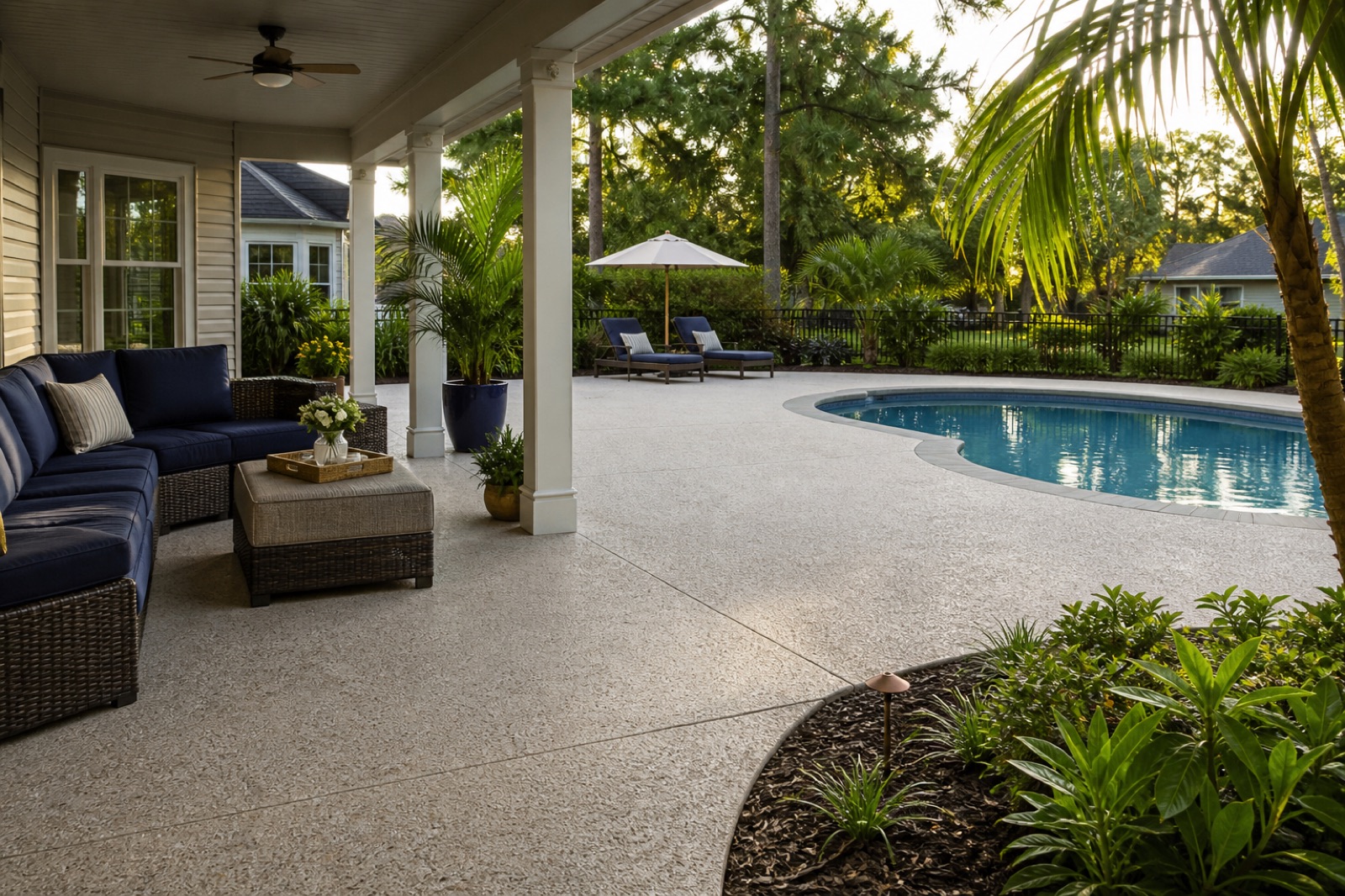
Residential coatings can make concrete feel more finished, easier to maintain, and better suited to vehicles, gatherings, projects, and everyday family use.
A garage, patio, basement, porch, and workshop each place different demands on a coating. Sunlight, moisture, tires, cleaning, texture, and the way your family uses the area all shape the recommendation.
South Carolina heat, humidity, storms, and strong sun make exterior exposure and slab moisture important parts of planning. Interior areas bring their own appearance, traffic, and maintenance goals.
The surface, surrounding finishes, traffic, and family routines all inform the final recommendation.
Different coating and overlay families support garages, interiors, porches, patios, and other prepared concrete.
The written scope identifies preparation, repairs, materials, access, cure restrictions, and care guidance.
Every project is defined around the actual concrete, location, intended use, selected finish, and conditions found onsite.
Discuss My ProjectProduct chemistry matters, but testing, concrete profile, repairs, mixing, timing, and cure protection create the conditions the system needs.
We discuss use, appearance, cleaning, sunlight, moisture, traffic, and the condition of the concrete.
The surface is profiled, detailed, cleaned, and repaired according to the selected system and written scope.
Compatible layers are applied, the cure is protected, and return-to-use guidance is reviewed.
Exact manufacturers and components are documented for each project rather than treated as a blanket claim.
The best starting point is where the concrete is located and what you need the finished surface to do.
Practical systems planned around tires, storage, cleaning, and daily traffic.
Explore option → 02Dense decorative color and texture for garages, workshops, and utility areas.
Explore option → 03Custom movement and depth for appropriate interior statement floors.
Explore option → 04Cementitious resurfacing for suitable concrete that needs a new patterned or textured finish.
Explore option → 05Fast-curing layers and UV-stable options within compatible complete systems.
Explore option → 06Professional cleaning and sealing for sound concrete that needs renewed appearance and protection.
Explore option → 07Mechanical grinding and clear protection that keeps the concrete's natural variation visible.
Explore option →These are general planning answers. The onsite condition and selected product system control the project-specific recommendation.
Request an estimate →It depends on location, exposure, moisture, traffic, desired appearance, cleaning needs, and the existing slab. We evaluate those conditions before recommending a system.
Some systems are appropriate for exterior concrete, while others are better suited to interiors. Sunlight, weather, drainage, texture, and moisture all affect the recommendation.
Cracks can often be cleaned and repaired before coating, but concrete can continue to move. A repair improves the surface; it cannot guarantee that a moving crack will never reappear.
Any smooth surface can be slippery when wet. Texture and slip-resistant aggregate can be considered based on the location, cleaning needs, and how the floor will be used.
Different resin families and decorative builds can play different roles. Explore related options before settling on a finish.
Tell us about the surface, how you use the space, and the finish you have in mind. We’ll evaluate the slab and recommend a practical next step.